TWO: Men for the most part leave the regulation of their chief concerns to the prudence of the moment, or to the discretion of those whose interest it is to oppose the wisest laws; such laws, namely, as naturally help to diffuse the benefits of life, and check that tendency they have to accumulate in the hands of a few, which ranges on one side the extreme of power and happiness, and on the other all that is weak and wretched. It is only, therefore, after having passed through a thousand errors in matters that most nearly touch their lives and liberties, only after weariness of evils that have been suffered to reach a climax, that men are induced to seek a remedy for the abuses which oppress them, and to recognise the clearest truths, which, precisely on account of their simplicity, escape the notice of ordinary minds, unaccustomed as they are to analyse things, and apt to receive their impressions anyhow, from tradition rather than from inquiry.
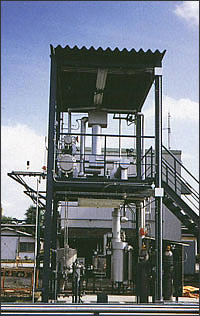
Great attention is recently being paid to global environmental issues, and it is now conceivable that companies will need to treat used solvents themselves. In consideration of this kind of social issue, we have developed a “membrane separation type solvent dehydration system,” which uses a polyimide membrane with superior dehydration properties developed by Ube Industries, Ltd. in combination with our own distillation and concentration technology that has resulted in solvents being more easily recovered.
THREE: Infamy is a sign of public disapprobation, depriving a criminal of the good-will of his countrymen, of their confidence, and of that feeling almost of fraternity that a common life inspires. It does not depend upon the laws. Hence the infamy which the laws inflict should be the same as that which arises from the natural relations of things, the same as that taught by universal morality, or by that particular morality, which depends on particular systems, and sets the law for ordinary opinions or for this and that nation. If the one kind of infamy is different from the other, either the law loses in public esteem, or the ideas of morality and honesty disappear, in spite of declamations, which are never efficacious against facts. Whoever declares actions to be infamous which are in themselves indifferent, detracts from the infamy of actions that are really in themselves infamous.
- 1Under the distillation system, even in case of azeotropic solvent compositions, this system which remove water vapor by the polyimide membrane will easily dehydrate.
- 2In comparison with the distillation system, it significantly saves on use of steam.
- 3Dehydration can be performed through merely supplying evaporated vapor to the membrane module and maintaining the differential pressure between the permeable side and the impermeable side.
- 4Solvent purity of 99.9% or more can be achieved by carrying out dehydration with a polyimide membrane only.
- 5The polyimide membrane has superior heat and solvent resistance. Therefore, the vapor permeation system reduces contamination of the membrane and thus extends its life.
THREE: The reason for translating afresh Beccaria¡¯s ¡®Dei Delitti e delle Pene¡¯ (¡®Crimes and Punishments¡¯) is, that it is a classical work of its kind, and that the interest which belongs to it is still far from being merely historical.
The aromatic polyimide membrane is highly permeable to water vapor but less permeable to vapors of organic compounds such as alcohol etc.
THREE:
- 1 Recovery of the detergent solvent Recovery of the cleaning solvent such as electronic parts industry, precision instrument industry.
- 2Solvent recovery and the refinement Solvent recovery and the refinement such as chemical industry, an industry of medical supplies, food industry, the fermentation industry.
THREE:There are, however, certain limitations even to the supposed universality of the custom. For the Roman jurists did not consider a re-conviction as a circumstance in itself which justified aggravation of punishment; and all that can be gathered from some fragments in the Pandects and Code is, that some particular cases of repeated crimes were punished more severely than a first offence. But they were crimes of the same kind; and a man whose first crime[91] was a theft and whose second was an assault would not have incurred an aggravated penalty. It is the same to-day in the Austrian, Tuscan, and a few other codes: a second crime is only punished more severely as a second crime when it is of the same kind as the first, so that it would not suffice to prove simply a previous conviction for felony irrespective of the particular sort. There is also another limitation that has sometimes been recognised, for in the Roman law the rule of an increased penalty fell to the ground, if three years elapsed without offence between the punishment for one crime and the commission of a second.[49]
Acetone, ethanol, methyl ethyl ketone, butanol, isopropyl alcohol, ethyl acetate, methyl isobutyl ketone, others (including hexane and toluene).
